|
About Fingerprint Identification / Fingerprint Biometrics
|
Human fingerprints are unique to each
person and can be regarded as a sort of signature, certifying the person's
identity. Because no two fingerprints are exactly alike, the process of
identifying a fingerprint involves comparing the ridges and impressions on one
fingerprint to those of another.
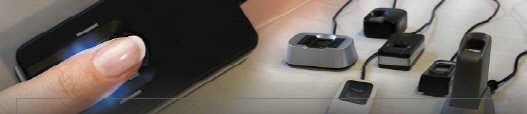
This first involves capturing the likeness
of the fingerprint, either through use of a fingerprint scanner (which takes a
digital picture of a live fingerprint), scanning a pre-existing paper-based
fingerprint image or by pulling what is known as a "latent
fingerprint" from a crime scene or other place of investigation, from
which a digital image is created.
|
|

|
Once the fingerprint image is captured, the
process of identification involves the use of complex algorithms (mathematical
equations) to compare the specific features of that fingerprint to the specific
features of one or more fingerprint images that have been previously stored in
a database.
Fingerprint Recognition Technology / Fingerprint Biometrics
The most famous application of fingerprint
recognition technology is in criminology. However, nowadays, automatic
fingerprint matching is becoming increasingly popular in systems which control
access to physical locations (such as doors and entry gates), computer/network
resources or bank accounts, or which register employee attendance time in
enterprises.
Straightforward matching of the
to-be-identified fingerprint pattern against many already known fingerprint
patterns would not serve well, due to the high sensitivity to errors in
capturing fingerprints (e.g. due to rough fingers, damaged fingerprint areas or
the way a finger is placed on different areas of a fingerprint scanner window
that can result in different orientation or deformation of the fingerprint
during the scanning procedure). A more advanced solution to this problem is to
extract features of so called minutiae points (points where the tiny ridges and
capillary lines in a fingerprint have branches or ends) from the fingerprint
image, and check matching between these sets of of very specific fingerprint
features.
The extraction and comparison of minutiae
points requires sophisticated algorithms for reliable processing of the
fingerprint image, which includes eliminating visual noise from the image,
extracting minutiae and determining, rotation and translation of the
fingerprint. At the same time, the algorithms must be as fast as possible for
comfortable use in applications with a large number of users.
Many of these applications can run on a PC,
however some applications require that the system be implemented on low cost,
compact and/or mobile embedded devices such as doors, gates, handheld
computers, cell phones etc.). For developers who intend to implement the
fingerprint recognition algorithm into a microchip, compactness of algorithm
and small size of required memory may also be important.
Related Products / Fingerprint Biometrics
VeriFinger Software Development Kit (SDK): In 1998 Neurotechnology developed VeriFinger, a
fingerprint identification algorithm, designed for biometric system
integrators. Since that time, the company has released 12 algorithm versions,
with the current version, VeriFinger 6.0, providing the most powerful
fingerprint recognition algorithms to date. VeriFinger SDK is offered for a
competitive price and developers can select from these types of SDK: • VeriFinger 6.0 Standard SDK is intended for
PC-based biometrical application development. It includes Matcher and Extractor
components, programming samples and tutorials, fingerprint scanner drivers and
software documentation. The SDK allows the development of biometric
applications for Microsoft Windows, Linux or Mac OS X operating systems. • VeriFinger 6.0 Extended SDK is intended for
biometrical Web-based and network application development. It includes all
features of Standard SDK. Additionally, the SDK contains sample client applications,
tutorials and a ready-to-use matching server.
FingerCell Embedded Development Kit (EDK): Neurotechnology's FingerCell embedded fingerprint
identification technology was developed on the VeriFinger basis and adapted for
use in low cost, compact and/or mobile embedded devices such as doors, gates,
handheld computers and cell phones. FingerCell 2.1 EDK is available
on 30 day trial period. This downloadable trial kit
allows developers to explore the technology and to try it in real environments
and real applications.
MegaMatcher Software Development Kit (SDK): MegaMatcher
is a multi-biometrical technology, intended for large-scale face-fingerprint
systems and AFIS integrators. The technology includes fingerprint and facial
recognition engines that could be used either separately or together. The
fingerprint engine's performance and reliability has been acknowledged by NIST
MINEX. MegaMatcher
2.0 SDK includes server software for local multi-biometrical systems,
cluster software for large-scale multi-biometrical products development, and a
set of valuable task-specific components.
Overview / PC-based Fingerprint Recognition Summary
Biometrical identification software have
been used in criminology for more than two decades, and now this software is
becoming an important part of various civil applications and systems, including
PC logon, employee access and attendance control, customer management systems.
A fingerprint identification system can be
designed using: 1. a common PC, that offers enough capabilities to perform fast
fingerprint recognition and matching, 2. a fingeprint scanner, that can be obtained
for an affordable price, 3. software, which can be rapidly
developed using a fingerprint identification SDK with all necessary
technologies, algorithms and interfaces included.
Once the software is developed, the system
can be scaled up by adding more PCs, scanners and obtaining additional
technology licenses.
Neurotechnology offers fingerprint
identification technology and SDKs that offer the needed performance and
reliability for a reasonable price.
The Technology / PC-based Fingerprint Recognition Summary
VeriFinger 6.0
technology is based on MegaMatcher 2.0 fingerprint
identification engine that has received NIST MINEX certification for use in
personal identity verification program applications. The technology assures
system performance with fast matching (up to 40,000 fingerprints per second) and
reliable fingerprint recognition. VeriFinger contains
many proprietary algorithmic solutions, including:
• adaptive image filtration for poor
quality fingerprints; • tolerance to fingerprint translation,
rotation and deformation; • identification (1:N) ability;
• features generalization for even more
reliable identification; • algorithm optimization for 30+ popular
fingerprint scanners.
Algorithm demo application is available for
downloading.
Read more about the
technology.
The SDK / PC-based Fingerprint Recognition Summary
VeriFinger SDK is based on
the VeriFinger fingerprint recognition technology and
is intended for biometric systems developers and integrators. It allows easy
integration and rapid development of biometric applications using functionality
from the VeriFinger algorithm, which ensures high
reliability of the fingerprint identification, 1:1 and 1:N matching
modes and comparison speeds of up to 40,000 fingerprints per second. The
integrator has complete control over SDK data input and output.
VeriFinger SDK supports Microsoft
Windows, Linux and Mac OS X. The following types of SDK are available:
• VeriFinger 6.0 Standard SDK is
intended for PC-based biometrical application development. It includes Matcher
and Extractor components, programming samples and tutorials, fingerprint scanner
drivers and software documentation. The SDK allows the development of biometric
applications for Microsoft Windows, Linux or Mac OS X operating systems.
• VeriFinger 6.0 Extended SDK is
intended for rapid development of biometrical Web-based and network
applications. It includes all features of Standard SDK. Additionally, the SDK
contains sample client applications, tutorials and a ready-to-use matching
server.
Why VeriFinger? / VeriFinger Fingerprint Recognition Technology
In 1998 Neurotechnology developed VeriFinger,
a fingerprint identification algorithm, designed for biometric system
integrators. Since that time, Neurotechnology has released more than 10
algorithm versions, providing the most powerful fingerprint recognition
algorithms to date.
The latest VeriFinger 6.0 version is based
on MegaMatcher 2.0
technology.
• Full MINEX Certification. VeriFinger 6.0
technology is based on MegaMatcher 2.0 fingerprint identification engine that
has been certified by NIST for use in personal identity verification program
applications. • Reliability. Even
earlier VeriFinger fingerprint identification algorithm versions consistently
have shown some of the best results for reliability in several biometric
competitions, including the International Fingerprint Verification Competition
(FVC2006, FVC2004, FVC2002 and FVC2000) and the National Institute of Standards
& Technology (NIST) Fingerprint Vendor Technology Evaluation (FpVTE 2003),
where Neurotechnology ranked among the top five companies for accuracy in
single-finger tests. VeriFinger 6.0 provides reliability improvements over
these earlier versions. • Fingerprint enrollment
time is 0.2-0.4 sec., and VeriFinger can match up to 40,000 fingerprints per
second in 1:N identification mode. To confirm these results with your data,
please try VeriFinger algorithm demo (see section
below). • VeriFinger matches rolled and flat
fingerprints between themselves. Usually conventional "flat"
fingerprint identification algorithms perform matching between flat and rolled
fingerprints less reliably due to the specific deformations of rolled
fingerprints. VeriFinger allows matching of flat-flat, flat-rolled or
rolled-rolled fingerprints with high reliability. • Both face and fingerprint recognition
technologies from the same vendor. Compatible product interfaces and customer
support from the same source allow simple multi-biometric system integration
and help to achieve high system recognition quality. The VeriFinger algorithm
can be used alone or together with other Neurotechnology's biometrical algorithms. •
VeriFinger is offered for a competitive price.
Developers can select from several types of SDK and licensing models. Each of
these kits and models is intended for specific needs, and developers always can
make an upgrade by paying the difference between the current and more powerful
SDK.
Algorithm / VeriFinger Fingerprint Recognition Technology
VeriFinger
algorithm follows the commonly accepted fingerprint identification scheme,
which uses a set of specific fingerprint points (minutiae). However, it
contains many proprietary algorithmic solutions, which enhance the system
performance and reliability. Some of them are listed below:
• VeriFinger includes fingerprint image
quality determination which can be used during enrollment to ensure that only
the best quality fingerprint template will be stored into database. • VeriFinger algorithm is able to match
rolled fingerprints, flat fingerprints, and also rolled with flat between
themselves. Due to the specific scanning technique (rolling from nail to nail)
rolled fingerprints usually have much bigger deformation than those scanned
using the "flat" technique. VeriFinger matches rolled fingerprints
very well, as it is tolerant to fingerprint deformations. • The adaptive
image filtration algorithm allows to eliminate noises, ridge ruptures and stuck
ridges, and extract minutiae reliably even from poor quality fingerprints, with
a processing time of about 0.2 - 0.4 seconds (all times are given for a Pentium
4, 3 GHz processor). You can look at the screenshot of the
VeriFinger demo application showing an example of initial fingerprint image
(left window), and the same image after the noise filtering and processing by
VeriFinger (right window), with minutiae positions and directions marked by red
circles and lines. • VeriFinger
functions can be used in1:1
matching (verification), as well as 1:N mode (identification). • VeriFinger
includes a fast template matching algorithm that is tolerant to fingerprint
translation, rotation and deformation. VeriFinger's proprietary fingerprint
matching algorithm allows it to match up to 40,000 fingerprints per second and
identify fingerprints even if they are rotated, translated, deformated and have
only 5 - 7 similar minutiae (usually fingerprints of the same finger have 20 -
40 similar minutiae). • VeriFinger can
use database entries which were pre-sorted using certain global features.
Fingerprint matching is performed first with the database entries having global
features most similar to those of the test fingerprint. If matching within this
group yields no positive result, then the next record with most similar global
features is selected, and so on, until the matching is successful or the end of
the database is reached. In most cases there is a fairly good chance that the
correct match will be found at the beginning of the search. As a result, the
number of comparisons required to achieve fingerprint identification decreases
drastically, and correspondingly, the matching speed increases. • VeriFinger has
the fingerprint enrollment with features generalization mode. This mode
generates the collection of the generalized fingerprint features from a set of
fingerprints of the same finger. Each fingerprint image is processed and
features are extracted. Then the features collection set is analyzed and
combined into a single generalized features collection, which is written to the
database. This way, the enrolled features are more reliable and the fingerprint
recognition quality considerably increases. • VeriFinger 6.0 includes
algorithm modes that help to achieve better results for the supported fingerprint
scanners.
Reliability Test Results and Technical Specifications / VeriFinger Fingerprint Recognition Technology
|
VeriFinger has been tested using
fingerprint sets from many scanners. Usually algorithm's recognition quality is
expressed by receiver operation characteristics (ROC) curves, that show the
dependence of false rejection rate (FRR) on the false acceptance rate (FAR). We
present ROC curves obtained from the databases collected with CrossMatch
Verifier 300 and DigitalPersona U.are.U 4000 scanners. These charts also
compare VeriFinger 5.0 (red curve) and VeriFinger 6.0 (green curve) algorithms
reliability.
As can be seen from the ROC curves,
VeriFinger 6.0 false rejection rate is only 0.13% with fingerprints from
CrossMatch Verifier 300 and 0.6% with fingerprints from DigitalPersona U.are.U
4000 at the false acceptance rate of 0.001%. The other specifications of the
algorithm are presented below. These parameters are given for a PC with 3 GHz
Pentium 4 processor.
|
VeriFinger 6.0 algorithm technical specifications
|
|
Required fingerprint resolution
|
> 250 dpi 500 dpi recommended
|
|
Fingerprint processing time
|
0.2 - 0.4 seconds
|
|
Matching speed *
|
up to 40,000 fingerprints/sec
|
|
Size of one record in the database **
|
150 bytes - 1.8 Kbytes (configurable)
|
|
Maximum database size
|
unlimited
|
|
|
Digital Persona U.are.U 4000
 Click to zoom
|
|
|
Cross Match Verifier 300 LC
 Click to zoom
|
| |
|
* VeriFinger 6.0, for sufficiently large
databases (500 or more fingerprints). Use with smaller sample fingerprint
database, typically yields lower speed.
** Average fingerprint with image size 300 x 300 pixels.
These results were also confirmed by the
tests performed by our customers.
Algorithm Demo / VeriFinger Fingerprint Recognition Technology
|
 Click to zoom
|
|
The VeriFinger demo application for
Microsoft Windows 2000/XP/2003/Vista can be downloaded for evaluation of the VeriFinger
fingerprint recognition algorithm. The application enrolls and identifies
fingerprints from image file or supported fingerprint scanner, and can
calculate receiver operating curves (ROC) with custom fingerprint databases.
Internet connection is not required to run the application.
Sample fingerprint images can be downloaded for evaluation purposes.
|
VeriFinger 6.0 Standard SDK and Extended
SDK trials are also available for downloading.
Related Products / VeriFinger Fingerprint Recognition Technology
These products are based on the VeriFinger
algorithm: • VeriFinger 6.0
Standard SDK • VeriFinger 6.0
Extended SDK
Overview / VeriFinger Fingerprint Identification SDK
VeriFinger SDK is based on the VeriFinger
fingerprint recognition technology and is intended for biometric systems
developers and integrators. It allows rapid development of biometric
applications using functionality from the VeriFinger algorithm, which ensures
high reliability of the fingerprint identification, 1:1 and 1:N matching modes and
comparison speeds of up to 40,000 fingerprints per second. VeriFinger can be
easily integrated into the customer's security system. The integrator has
complete control over SDK data input and output.
VeriFinger SDK supports Microsoft Windows,
Linux and Mac OS X.
Contents of VeriFinger 6.0 Standard & Extended SDK / VeriFinger Fingerprint Identification SDK
The following VeriFinger 6.0 SDKs are
available: • VeriFinger 6.0
Standard SDK is intended for PC-based biometrical application development. It
includes Matcher and Extractor components, programming samples and tutorials,
fingerprint scanner drivers and software documentation. The SDK allows the
development of biometric applications for Microsoft Windows, Linux or Mac OS X
operating systems. • VeriFinger 6.0 Extended SDK is intended for
biometrical Web-based and network application development. It includes all
features of Standard SDK. Additionally, the SDK contains sample client
applications, tutorials and a ready-to-use matching server.
The table below compares VeriFinger 6.0
Standard SDK and VeriFinger 6.0 Extended SDK.
|
|
VeriFinger Standard SDK
|
VeriFinger Extended SDK
|
|
Components
|
MS Windows (32 & 64 bit)
|
Linux (32 & 64 bit)
|
Mac OS X
|
MS Windows (32 & 64 bit)
|
Linux (32 & 64 bit)
|
Mac OS X
|
| • VeriFinger 6.0 Extractor
|
1 license
|
3 licenses
|
| • VeriFinger 6.0 Matcher
|
1 license
|
1 license
|
| • Scanners support module
|
+
|
+
|
+
|
+
|
+
|
+
|
|
VeriFinger Matching Server
|
| • Matching server software
|
|
|
|
+
|
+
|
|
| • Server administration tool API
|
|
|
|
+
|
+
|
|
| • Microsoft SQL Server support module
|
|
|
|
+
|
|
|
| • MySQL database support module
|
|
|
|
+
|
+
|
|
| • Oracel database support module
|
|
|
|
+
|
+
|
|
| • SQLite database support module
|
|
|
|
+
|
+
|
|
|
Programming samples
|
| • C/C++
|
+
|
+
|
+
|
+
|
+
|
+
|
| • C#
|
+
|
|
|
+
|
|
|
| • C# web client (for Matching Server)
|
|
|
|
+
|
|
|
| • Sun Java 2
|
+
|
+
|
|
+
|
+
|
|
| • Sun Java 2 web client (for matching server)
|
|
|
|
+
|
+
|
|
| • Visual Basic 6
|
+
|
|
|
+
|
|
|
| • Visual Basic .NET
|
+
|
|
|
+
|
|
|
| • VBA (Microsft Access 2003)
|
+
|
|
|
+
|
|
|
| • Delphi 7
|
+
|
|
|
+
|
|
|
|
Programming tutorials
|
| • C
|
+
|
+
|
+
|
+
|
+
|
+
|
| • C/C++ (for Matching Server)
|
|
|
|
+
|
+
|
|
|
• C#
|
+
|
|
|
+
|
|
|
|
• C# (for Matching Server)
|
|
|
|
+
|
|
|
|
• Visual Basic 6
|
+
|
|
|
+
|
|
|
|
• Visual Basic .NET
|
+
|
|
|
+
|
|
|
|
• Delphi 7
|
+
|
|
|
+
|
|
|
|
Documentation
|
|
• VeriFinger 6.0 SDK documentation
|
+
|
VeriFinger Matching Server / VeriFinger Fingerprint Identification SDK
VeriFinger Matching Server software is not
included in VeriFinger 6.0 Standard SDK.
VeriFinger Matching Server is a
ready-to-use software that performs the identification and verification of
fingerprints on the server side. The server is intended to be used in web-based
and other network-based systems.
VeriFinger Matching Server runs on PCs with
Microsoft Windows or Linux and includes these additional components: • Server administration tool for monitoring
servers state, managing log and other server administration tasks; • Support modules for MySQL and Oracle
databases. • Sample client applications: ° C# tutorials (for Microsoft Windows); ° C sample (for Linux); ° Sample Java applet.
VeriFinger Extractor Component / VeriFinger Fingerprint Identification SDK
VeriFinger Extractor creates fingerprint
templates from fingerprint images. Image quality control can be applied to
accept only good quality fingerprint images.
The Extractor can generalize a fingerprint
template from several fingerprint images to improve template's quality.
VeriFinger Matcher Component / VeriFinger Fingerprint Identification SDK
VeriFinger Matcher performs fingerprint
template matching in 1:1
and 1:n modes.
System Requirements / VeriFinger Fingerprint Identification SDK
System requirements for VeriFinger Mathing
Server • PC with x86 compatible CPU (2 GHz processor
or better is recommended); • UDP and TCP network support; • MySQL or Oracle server (other DB servers
require a custom support module to be developed by the integrator); • Microsoft Windows specific: ° Microsoft Windows 2000/XP/2003/Vista. • Linux specific: ° Linux 2.6 or newer; ° GCC-4.0.x or newer; ° pkg-config-0.21 or newer; ° GNU Make 3.81 or newer; ° GTK+-2.10.x or newer libs and dev packages;
° libtiff-3.8.x or newer libs and dev
packages;
System requirements for VeriFinger Matcher
and Extractor components: • PC with x86 compatible CPU (2 GHz processor
or better is recommended); • UDP and TCP network support (for
network-based applications); • Fingerprint scanner driver (users can use
the fingerprint scanning component, included in VeriFinger SDK, or can obtain
the driver from the scanner's manufacturer); • Microsoft Windows specific: ° Microsoft Windows 2000/XP/2003/Vista; ° Microsoft .NET framework 2.0 (for .NET
components); ° Microsoft Visual Studio .Net 2005 or newer,
or Microsoft Visual Basic 6 (for application development). • Linux specific: ° Linux 2.6 or newer; ° GCC-4.0.x or newer; ° pkg-config-0.21.x or newer; ° GNU Make 3.81 or newer; ° GTK+-2.10.x or newer libs and dev packages;
° libtiff-3.8.x or newer libs and dev
packages;
Additional Products / VeriFinger Fingerprint Identification SDK
These products can be used together with
VeriFinger SDKs: • Template Management and
Conversion Add-on – a product for template
standards support integration with systems based on VeriFinger SDK or
FingerCell EDK. • NImages Pro (WSQ) Add-on
for VeriFinger – allows developers to
integrate image support into applications based on VeriFinger SDK or FingerCell
EDK. Supported image formats are: WSQ, BMP, TIFF and NIST IHead.
SDK Trials / VeriFinger Fingerprint Identification SDK
Neurotechnology offers VeriFinger 6.0
Standard SDK and Extended SDK on a 30 day trial. The trials allow developers to
explore the SDKs' possibilities and to try them in real environments and real
applications. Constant Internet connection is required during evaluation.
VeriFinger SDK trials are available for downloading.
The VeriFinger 6.0 algorithm demo
application for Microsoft Windows is also available for downloading.
Licensing VeriFinger
To develop a product based on VeriFinger
6.0 technology, an integrator should obtain VeriFinger 6.0 Standard SDK (EUR
339) or VeriFinger 6.0 Extended SDK (EUR 859). Integrators can develop only an end-user
product using VeriFinger SDK and sell/install the product to their own
customers.
If an integrator wants to develop and sell
a VeriFinger based development tool (with custom API, programming
possibilities, samples, etc.), he/she will need to become a value-added
reseller (VAR). More information is available in VAR licensing
model.
VeriFinger 6.0 components are: • VeriFinger 6.0 Matcher • VeriFinger 6.0 Extractor
A license is required for each running
instance of VeriFinger components. The following license types are available: • Single
computer license. • Concurrent
network license. • Enterprise
license.
VeriFinger 6.0 Standard SDK includes: • 1 VeriFinger Matcher license. • 1 VeriFinger Extractor license.
VeriFinger 6.0 Extended SDK includes: • 1 VeriFinger Matcher license. • 3 VeriFinger Extractor license.
VeriFinger 6.0 SDK customers can obtain
additional VeriFinger 6.0 components licenses for their product installation or
development at any time. Prices for additional VeriFinger 6.0 component
licenses can be found here.
Please also refer to VeriFinger 6.0 SDK
Software License Agreement for all licensing terms and conditions.
Single computer license
A single computer license allows to install
and run a VeriFinger 6.0 component installation on one processor core.
Component license will not be lost if computer will be reinstalled.
The following license management options
are available: • license activation online by communicating
with Neurotechnology's server; • license activation by email; • license activation using volume
license manager; • license management using volume
license manager on LAN or Internet.
Concurrent network licenses
VeriFinger Extractor concurrent license
allows to install VeriFinger Extractor component on an unlimited number of
computers. Volume
license manager is used to manage these licenses across the computers on
LAN or Internet. The allowed number of simultaneously running VeriFinger
Extractor component instances is limited by the number of obtained concurrent
licenses which are stored in the license manager.
This type of licensing is especially useful
for web-based software.
VeriFinger 6.0 enterprise license
VeriFinger enterprise license allows an unlimited
use of VeriFinger components (Extractor and Matcher) in the end-user products
in the certain territory, market segment or project. These limitations would be
included in the licensing agreement.
The enterprise license price depends on the
application size and the number of potential application's users within the
designated territory, market segment or project. VeriFinger enterprise licenses
are provided only for big projects, with price range starting at EUR 20,000.
VeriFinger algorithm source code may be
included with a special source code licensing agreement for the selected
customers, who are going to obtain VeriFinger enterprise license for at least
EUR 100,000 or more.
For more information please contact us.
|